The Algorithm Took Your Agency. Here’s How to Take It Back.
On building a direct audience and an AI agent to help grow it

I’m a late Gen-X’er, which means I have an affection for the 90s that probably clouds my judgment.
When Paramount/SkyDance announced earlier this year that they would shut down MTV’s music channels after already shutting MTV News and its archives, there were a lot of wistful elegies for the culture we once had. FX has built a cottage industry of dramatized series set in the era. You hear how there is no more independent film or independent music. Media ownership has consolidated into fewer and fewer hands — studios merging, private equity rolling up what’s left of local news, billionaires acquiring the infrastructure of public discourse.1
These things are true.
It also misses the point. Culture isn’t gone. It’s just not found in traditional media spaces if that’s where you were looking.
A filmmaker with something to say today isn’t waiting for Sundance to validate them. They’re on YouTube before they’d ever approach a distribution system that would probably lock them out anyway. A musician shaping culture right now isn’t coming from an indie rock scene most people lamenting the collapse are still listening to. They’re often found on TikTok or SoundCloud — and more likely to come from culture originating outside the U.S., like Reggaeton, K-Pop, Afrobeats, genres that didn’t need the American music industry’s permission to reach American audiences.
Distribution was a chokepoint in the 90s. Something else took its place.
Distribution Was the Chokepoint. The Internet Fixed It.
In the 90s, independent culture was vying for access to a system it couldn’t fully control. Sundance was a door to theatrical distribution. Sub Pop and Matador were a door to record store shelves and radio play. Image Comics — founded in 1992 when seven of Marvel’s top artists walked out and started their own creator-owned studio — was a door to comic shop distribution and mainstream retail.
The cultural energy was real. Grunge, hip-hop, independent film, creator-owned comics. People making things outside the institutional system, and audiences hungry for them.
But they were still largely dependent on that legacy distribution system to reach audiences. Getting noticed required getting into the system — or building enough pressure outside it that the system came to you.
Over the next 30 years, the internet collapsed the cost of distribution to near zero. The pipe opened to everyone. I wrote about what this meant for creators in a recent piece, “You’re In the Creator Economy Now.”
Now there’s a new chokepoint, and that’s where this piece picks up.
The Algorithm Is the New Gatekeeper — and It’s Invisible by Design
The 90s gatekeeper was visible. If you were a filmmaker and your film couldn’t get into theaters, that’s because it didn’t have distribution. If you were a musician and your music wasn’t in stores or played on the radio, it’s because no record label picked it up. The barrier was a known and named system. You could see the door and figure out how to knock on it — or create pressure through cultural resistance. Most of the cultural breakthroughs of the 90s happened this way.
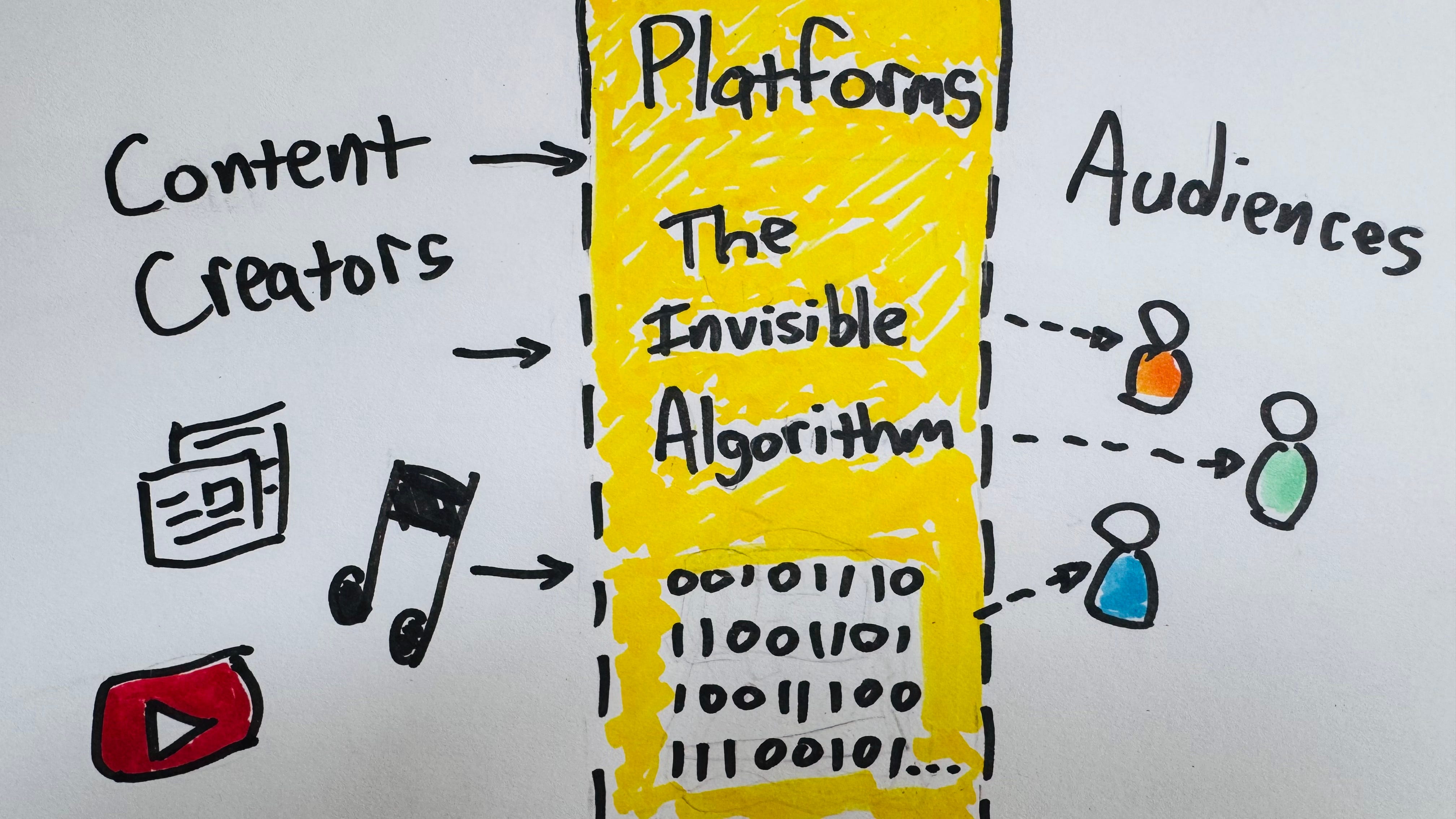
Today, the chokepoint is the social media algorithm. It’s a ranking system with rules and mathematical probabilities encoded by computers to match content to individuals, tuned and managed by engineers at the direction of a small handful of companies to maximize their revenue. It is largely invisible and mysterious to the creators and audiences it mediates.
danah boyd — researcher and social media scholar who has studied these platforms for two decades — recently named what happened. She argues that social media has become parasocial media: platforms built not for genuine connection between people, but for one-directional performance optimized for engagement metrics.
You don’t post to connect anymore. You post to perform for an algorithm that decides whether to amplify you.
Audiences don’t experience this as withholding. They experience it as an endlessly scrollable feed — a bottomless recommendations tab of content “you might also like.” They don’t see what’s being filtered out. They only see what the platform decided to show them, optimized for the engagement metric that serves the platform’s business model.
This phenomenon doesn’t only affect creators seeking an audience. It affects anyone navigating these platforms with a purpose — including job seekers. I feel it on LinkedIn every day. My network doesn’t see what I publish. The algorithm decides who gets it, when, at what volume — and the logic is opaque by design.
The distribution chokepoint moved from physical retail and broadcast infrastructure to platform algorithms. The gatekeeping function didn’t disappear. It became invisible and unaccountable. And it affects both sides: creators can’t reliably reach audiences they’ve built, and audiences can’t reliably find things they’d want if they could find them. The platform captures the value that should flow between them.
About a decade ago, there was a symbiotic relationship between platforms and publishers — platforms sent traffic to publishers. That era is over. The chokepoint is in effect. Social media traffic is gone. Search traffic is rapidly declining. So as a publisher or creator, how can you resist and connect with your audience?
Substack Isn’t a Safe Harbor. It’s a Better Bet.
The conventional response to platform dependency is to build a direct audience. Email list. Owned channel. Something the algorithm can’t touch. That’s the actual asset — not the follower count as mediated by a platform, but a verified list of people you can reach who are opted in.
That’s what I’m trying to do here on Substack. And if you’ve spent any time here, you know I’m not alone.
But why Substack specifically, rather than any email tool? Isn’t this just another platform that will end up the same way?
Three reasons, in order of importance.
First: incentive alignment. Substack makes money when creators make money — through paid subscriptions, not advertising. That’s a structurally different relationship than a platform selling the audience’s attention to advertisers. LinkedIn’s incentive is to keep you scrolling, consuming, and increasingly interacting with ads — or content masquerading as ads. Substack’s incentive is to help you convert readers into paying subscribers. Those produce different product decisions.
Second: network effects that other newsletter tools don’t have. Notes — Substack’s short-form feed, where writers share observations and restack each other’s work — create real social mechanics for discovery within the platform. It is still early stage and more organic than what LinkedIn or Twitter eventually became, but the same building blocks. Which means Substack has a plausible path to becoming a meaningful discovery layer for written work.
It also means Substack is subject to the same enshittification trajectory Cory Doctorow identified — and that danah boyd has applied to social platforms more broadly. A platform that starts aligned with creators can drift toward optimizing for its own engagement metrics as it scales. Substack is not immune. I’m watching it with eyes open.
Third: email-native delivery. A subscriber who signs up gets my writing in their inbox regardless of what Substack’s algorithm does that week.
The list travels even if the platform doesn’t.
That’s the bet. Not that Substack is permanent. That its incentive structure, network mechanics, and email-native delivery make it a better foundation than the alternatives available right now.
The Agent That Replaced My Feed
Deciding to build on Substack told me where I wanted the audience to live. It didn’t tell me how to find the people worth engaging with to grow it.
The answer to that problem, on any platform, is supposed to be the feed. Browse, scroll, discover, engage. But the feed is the algorithm’s answer, not mine. What surfaces there is optimized for platform engagement, not for my specific interests or the specific neighborhood of writers I’m trying to be part of.
So over spring break I built an alternative. I’m calling it the Signal Pipeline.
Every morning it scans the 44 Substack publications I identified through a combination of my own seed list and a crawl of the recommendation graphs of writers I already trusted — all working at the intersection of media, product leadership, AI, and the creator economy. For each new post, it runs a relevance score against five topic clusters derived from my own reaction history: what I’ve actually engaged with across two years of reading and reacting on Substack and LinkedIn. The scoring isn’t guessing at my interests. It’s derived from what I’ve already demonstrated I care about.
Posts that score above a threshold get a second pass. The system fetches the full text and uses an AI model to identify the most quotable passage and suggest two or three commentary angles specific to my background — my NBC News experience, my current positioning, the argument I’m already making in my writing. Posts that don’t clear the threshold still appear in the digest with their scores, so I can sanity-check what the system is skipping.
By the time I’m at my desk, the digest is already waiting. Review takes about five minutes. Then I choose what to engage with and write the commentary myself — typically ten to fifteen minutes per restack. What used to take one to two hours of manual browsing is now a five-minute review. The writing is still mine.
The discovery is automated. The judgment is not.
Before this: 11 articles published over six weeks, ending in March. 26 subscribers. Spring break, I built the pipeline. Mid-April, I started the restacking habit. Two weeks later: 42 subscribers. I’d published 11 articles before without this kind of movement. Content alone wasn’t moving the needle. Showing up consistently in the Notes feed, engaging with specific authors and their work — that’s what changed.
I’m not claiming causation. I’m reporting a before/after that’s hard to ignore.
What I’m doing is small. But I don’t think I’m the only one heading this direction.
Boyd named the disease. My LinkedIn feed is the symptom. What Dan Porter — serial entrepreneur, most recently founder and CEO of Overtime Sports — and Elena Verna — who helped define the Product Led Growth movement and is now Head of Growth at Lovable — are describing from their respective corners is the early shape of a response.
Porter recently wrote about agents replacing the open browser tab on the consumer side. You don’t browse for a restaurant or search and scroll fantasy football analysis on websites. You tell your agent what you want. The platforms and publishers currently sitting between you and that answer are the ones at risk.
Verna is making the same argument from the B2B side: if your product isn’t accessible to agents, you’re not part of the workflow anymore. A human user may never touch your product. The agent decides and does things.
Consumer behavior, B2B software, media audience development — three completely different problems, same structural observation.
The platforms took your agency — over what you find, over who finds you. Building your own agent, however small and imperfect, is a way of taking some of that back.
You decide what signal looks like. You decide what’s worth engaging with. The algorithm doesn’t get to make that call anymore.
That’s worth building toward. Even at this stage.
Whatever… nevermind — says my Gen-X inner voice
Good perspective, Josh. There was always a gatekeeper. With infinite content fighting for finite attention, there has to be. All that's changed is that now it's an invisible robot, and I'm here in hope of limiting its power too.