What You Do When Things Go Wrong — And When They Go Right
The gap between knowing the right behaviors and actually doing them under pressure

There’s a question that comes up frequently in senior leadership interviews:
What kind of leader are you? What kind of culture do you build?
I’ve answered this question a lot lately. I’m in the middle of a job search, which means I’ve had more of these conversations in the past several months than in the previous several years combined. And the more I’ve given it, the more it’s come into focus.
I talk about being a player/coach — someone who is in the work with their team, not above it. And I talk about two things I try to hold at the same time: playing to win and playing the game well.
Playing to win means knowing the business impact you want to create and going after it. That part is table stakes. Every leader says some version of it.
Playing the game well is something different. Process and tactics matter — how you break down work, how you prioritize, how you communicate with senior executives and stakeholders. But those things sit on top of something more foundational. Playing the game well is about the attitude and behavior you bring to the work — and whether you can inspire those behaviors and make them contagious across your team and throughout your organization.
I wrote about this foundation before — in a piece about The Mindset Underneath the Work, built around four videos I shared with my team during our annual reviews: Giannis on failure, Kara Lawson on hard things, Fred Rogers reframed, Bruce Lee’s “be water.” That piece was about internal orientation — how you show up inside yourself. This one is about how that orientation shows up in your behavior toward others.
You Already Know Which Side You Want to Be On
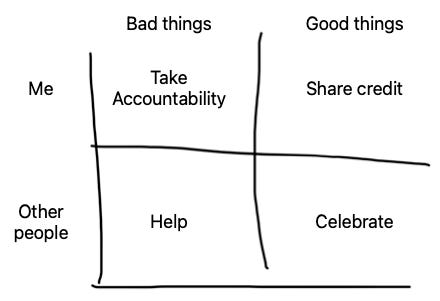
I’ve been working through this as a simple diagram. Two grids — call them the Wrong Frame and the Right Frame. Four situations mapped across both: bad things happening to you, good things happening to you, bad things happening to others, good things happening to others.
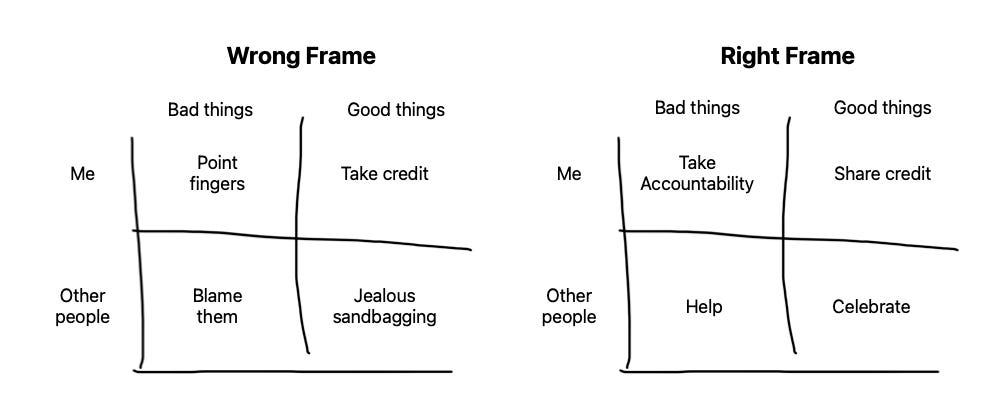
Here’s what the Wrong Frame looks like:
Bad things happen to you → point fingers
Good things happen to you → take credit
Bad things happen to others → blame them
Good things happen to others → jealous sandbagging
And the Right Frame:
Bad things happen to you → take accountability
Good things happen to you → share credit
Bad things happen to others → help
Good things happen to others → celebrate
Look at that and you know exactly which side you want to be on. Every leader does.
That’s the problem. This looks obvious. But in practice it is not easy.
The Wrong Frame isn’t where bad leaders live. It’s the default — the path of least resistance when things get hard, in competitive environments, in organizations where the incentives are running the wrong direction. The Right Frame is what you have to actively choose, repeatedly, under conditions that consistently make the other choice easier.
The Wrong Frame isn’t where bad leaders live. It’s the default.
Knowing What to Do and Actually Doing It Are Different Things
When something goes wrong and fingers are pointing, the instinct to defend is immediate. I’ve been in situations where I’ve felt it — the frustration, the unfairness, the urge to point at everything that contributed to the failure that wasn’t mine. That’s human. What I’ve learned is that the feeling needs somewhere to go — a private conversation, a trusted advisor, a moment to process before a better response takes form. The reframe isn’t about suppressing the reaction. It’s about making sure that reaction doesn’t become your public behavior.
A manager said something to me once that I didn’t love hearing in the moment: “It might not be your fault, but it is your problem.” My first read was defensive — why is this my problem alone? But that wasn’t what he meant. He meant that everything within my purview — my teams, my projects, the external forces landing on us — was mine to own. Not to blame myself for. To show up for. To be accountable for solutions, not just causes.
It might not be your fault, but it is your problem.
That connected to something I wrote about in The Mindset Underneath the Work: it’s not your problem or their problem, it’s just the problem. Move from MY problem to THE problem — and something unlocks. Blame has nowhere to land. The defensive energy dissipates. People can actually start working on it together. There’s a time for root cause analysis, but when you’re fighting a fire you first need to put out the fire. Blame while the fire is burning makes the fire worse and the blame land harder.
Move from MY problem to THE problem — and something unlocks.
The same dynamic plays out on the other side of the framework when good things happen — and it’s just as damaging. Leaders don’t fail to celebrate because they’re malicious. They fail because they’re busy, stressed, and focused on what’s next. The absence accumulates invisibly — and by the time morale shows up damaged, it’s been building for months.
I’ve been called out for this before. I used to give broad team-wide thanks after a big push — “great work everyone, really proud of what we accomplished” — and I meant every word of it. What I didn’t understand then is that non-specific recognition can land as disingenuous, even when it’s genuine. The people doing the work know that senior leaders often don’t have visibility into who did what. A blanket thank-you can feel like confirmation of that distance rather than a bridge across it.
What actually motivates people is specific, accurate praise. A VP who knows that a particular engineer solved a problem nobody else could crack, and says so by name, lands completely differently than “the team did great work.” You can’t always thank everyone, and some people don’t want to be singled out publicly. But a private note with a specific observation costs almost nothing and matters enormously.
The Tone You Set Becomes the Environment Your Team Works In
These behaviors aren’t just a reflection of individual character. They’re a reflection of conditions. A team that feels blamed will become defensive. A team whose credit gets absorbed upward will feel unseen and lose motivation. A team that isn’t celebrated will stop celebrating each other.
As a leader you are shaping those conditions whether you intend to or not. The behavior you model sets the conditions for what others feel permitted to do. A leader who takes accountability publicly — who says “that was my call and it didn’t work, here’s what I’d do differently” — gives their team permission to do the same. People stop managing their exposure and start solving the problem. The inverse is equally true and faster: one visible deflection of blame can reset months of trust in a single meeting.
One visible deflection of blame can reset months of trust in a single meeting.
Most of the time you won’t be making a conscious choice between the two frames — you’ll just be reacting. The work is catching yourself. Noticing when the defensive response is right there, easier and more satisfying than the alternative, and asking: what would this look like if I chose the other path?
That question, asked often enough, changes what your team feels permitted to do.
It looks obvious until you’re in it.